The Presence Test
Ian McKellen told Stephen Colbert that theatre is an irreplaceable human encounter, then described a production where the actors aren't in the room at all. The contradiction between these two claims may be more useful than either one alone.

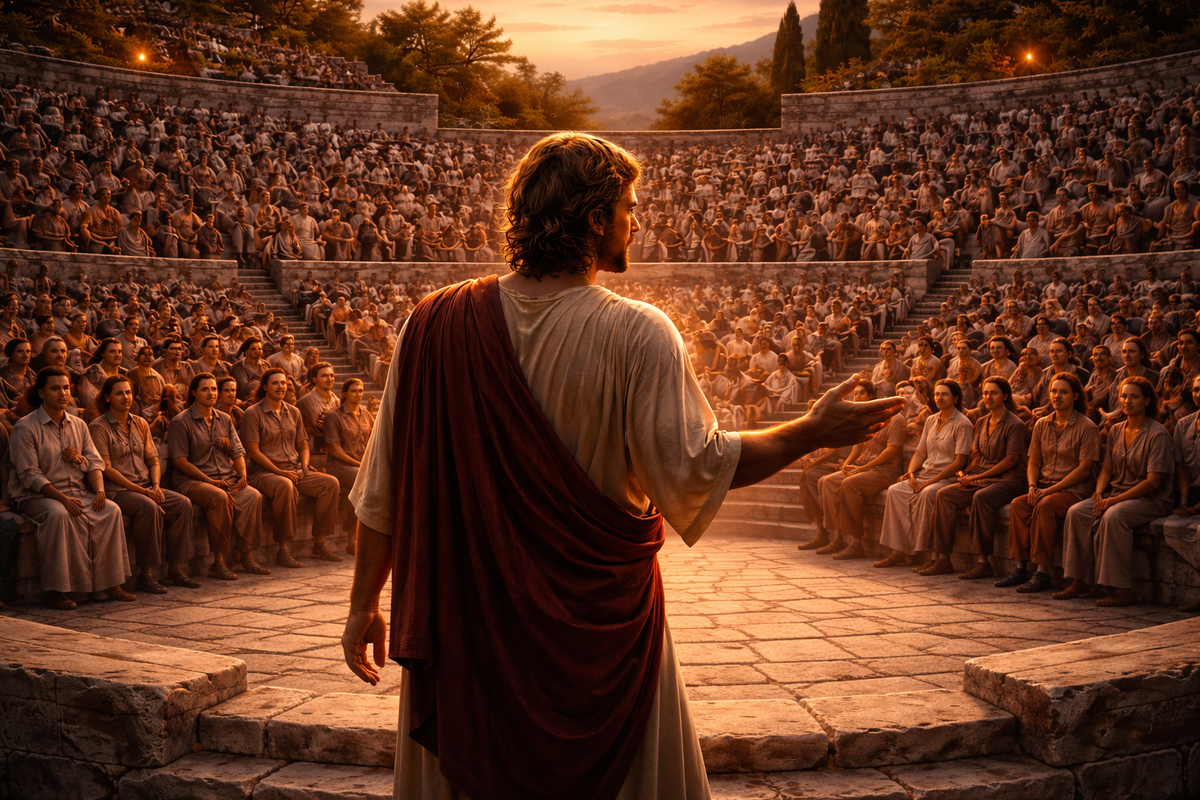
When a man who has spent sixty years on stage tells you the future of theatre is a room where no actor is physically present, you should probably pay attention. And then think very carefully about what he's actually saying.
Something happened on late-night television recently that deserves more attention than it got. Not the Shakespeare, though the Shakespeare was extraordinary. A quieter thread running through the conversation. A thread about presence, simulation, and what happens when we try to technologize the one thing that might resist it.
Ian McKellen sat across from Stephen Colbert and did what McKellen does: he made the room more alive by being in it. Over the course of a conversation that wandered from Gandalf to smart glasses to a four-hundred-year-old speech about immigrants, he articulated something I've been circling for months, something I tried to get at in The Reality Hunger but hadn't quite found the right frame for.
The frame, it turns out, is a contradiction. And contradictions, when they're honest, tend to be more useful than arguments.
The irreducible encounter
McKellen describes the theatre as an unrepeatable human encounter — real people sharing real space, breathing the same air, reacting together in a way no recording can replicate. For him, the magic lies in that collective presence: the actor speaks, the audience responds, and something alive passes between them.
Sixty years on stage earns you the right to make claims like that. This is a man who has performed in more rooms, for more audiences, across more decades than most of us will experience in any domain, and what he keeps coming back to is the breathing. The shared breathing. When someone with that depth of practice tells you that's where the magic lives, you should probably take it seriously.
Colbert, who understands the mechanics of live performance better than most interviewers, distills the idea to its core: in an age of synthetic content, theatre remains humans doing something with humans, by humans, for humans — a reminder that the real thing still matters.
I wrote in The Reality Hunger about presence as something simulations cannot replicate. Being somewhere, actually there, with a body that occupies space and senses that take in unfiltered input: that differs from any representation of that experience. The felt sense of presence involves dimensions screens and speakers cannot capture. McKellen and Colbert aren't making a theoretical argument. They're reporting from the field. Sixty years of evidence, condensed into a few sentences on a late-night couch.
McKellen ends his reflection with a quiet warning: the real thing only happens when you're actually there. Theatre, he says, is a human encounter that can't be mediated through a screen; a moment you can only catch if you're not staring at your phone. It's a reminder that the authentic experience still requires presence.
That word, presence, is doing a lot of work. More than McKellen probably intends. Because presence isn't just about theatre. It's about everything that matters: every conversation where tone carries more than words, every negotiation where you read the room before anyone speaks. The irreducible fact of being in the same space, at the same time, subject to the same conditions, with nothing optimized and nothing replayable and nothing filtered between you and the other person.
The strange new frontier
And then McKellen describes An Ark.
An Ark is a production currently running at The Shed in New York. The audience sits together in a room (shoes off, as it happens, which is either a meaningful ritual gesture or a practical requirement of the technology, or both) and each person wears mixed reality glasses that conjure actors who aren't physically there. McKellen, Golda Rosheuvel, Arinzé Kene, Rosie Sheehy: captured volumetrically by fifty-two cameras in Grenoble, reconstructed in three dimensions, projected into your field of vision so vividly you feel you could reach out and touch them.
It isn't film, and it isn't theatre as we've known it. McKellen puts it with characteristic directness:
"I don't know whether it's the future, but it's certainly not the past." Sir Ian McKellen
That sentence is worth sitting with. A man who has just told you that the irreplaceable magic of theatre is the shared breath, the collective presence, the unrepeatable human encounter, is now telling you about a form where the actors aren't in the room. The encounter mediated through technology. The "presence," by any traditional measure, simulated. And he's excited about it, genuinely excited, describing the mixed reality experience as making him appear "even more real" than if he were standing on the stage. He calls it startlingly new.
Holding the contradiction
Most commentary I've seen resolves this in one direction or the other. Either McKellen is right about presence and An Ark is a gimmick, or An Ark is the future and the talk about shared breathing is sentimentality. Technology boosters claiming vindication on one side, theatre traditionalists clutching their pearls on the other, and both of them, I think, missing the point.
Or maybe I'm the one missing something. But I keep returning to the idea that the contradiction is the point, and that it maps onto something I've been thinking about since writing The Reality Hunger: the relationship between what is real and what is authentic turns out to be more complicated than either the technologists or the romantics want to admit.
McKellen isn't confused. He's holding two things at once. The theatre is an irreducible human encounter. And this new form, which removes the physical actor from the room, creates a different kind of encounter that has its own authenticity. Something else entirely, something that doesn't have a name yet, that resists the categories we have for it.
The reviews of An Ark are mixed, which is what you'd expect from a genuinely new form. Some reviewers found the technology distracting, the resolution inadequate, the experience less moving than seeing the same actors from the back of a traditional theatre. Others reported something uncanny: the sense that McKellen was looking directly at them, speaking to them personally, present in a way that a stage performance (where the actor projects to hundreds) cannot achieve.
Both responses are probably honest. And both confirm something: we're at a threshold where the categories themselves are shifting.
What the paradox reveals
In The Reality Hunger, I argued that reality is becoming the next cultural frontier. As synthetic media saturates our environment, the unmediated encounter becomes scarce, and what is scarce becomes valuable. I still believe this. The fatigue with synthetic everything is real and growing.
But McKellen's contradiction complicates the argument in a way I find productive. What he's describing with An Ark isn't synthetic media in the way we usually mean the term. Not a deepfake, not AI-generated content. A recording of a real performance, captured with extraordinary fidelity, presented in a spatial format that creates a different relationship between performer and audience. The actor's performance is real. The audience's experience of it is real. What's missing is the shared physical space.
So the question becomes: is shared physical space the thing that makes an encounter real? Or is it one of several things, and some of the others might be achievable through new means?
I don't think McKellen knows the answer. I don't think anyone does yet. That's what makes his honest uncertainty ("I don't know whether it's the future") more valuable than anyone's confidence.
What I find most interesting is what he doesn't say. He never claims An Ark replaces theatre, never suggests it's better. What he says is that it's not the past, that it's something new, and then in the same conversation he reaffirms that the irreplaceable thing about traditional theatre is the shared human presence. He's describing a landscape that has more room in it than either camp wants to acknowledge. I keep turning this over.
The presence test
Here's where I want to push beyond what McKellen says, into what I think his contradiction implies.
We're entering a period where the question "is this real?" gives way to something more interesting: "what kind of real is this?" The binary (real versus simulated, authentic versus synthetic, present versus mediated) may be less useful than a spectrum, and the relevant measure along that spectrum has less to do with technology than with experience.
Call it the presence test. Not whether the person is physically in the room, but whether the encounter feels alive. Whether it resists prediction, demands something from you, leaves a mark.
By that test, a distracted conversation at a dinner party where everyone is on their phones might score lower than a mixed reality theatre piece where a volumetrically captured Ian McKellen looks you in the eye and tells you about death. Physical co-presence failing the test while a mediated, reconstructed encounter passes it.
I'm not comfortable with this conclusion, which is probably a sign that it's worth exploring further.
The fatigue I described in The Reality Hunger is real. People are tired of synthetic everything, of optimized content, of mediated experience. The hunger for the actual, the unfiltered, the physically present: that's genuine, and it's growing. But the hunger isn't for physical co-presence per se. It's for something deeper. For encounters that treat you as a human being rather than an engagement metric, experiences that carry weight and consequence and irreversibility, contact with something (or someone) that isn't designed to manipulate you into staying a few seconds longer.
McKellen's excitement about An Ark isn't a betrayal of his love for traditional theatre. It extends the same principle. What he values, I think, is the encounter itself, and he's discovered, to his apparent surprise, that a new technology can create a form of encounter he hadn't imagined.
The deeper scarcity
So maybe the scarcity I identified in The Reality Hunger needs refining. What's becoming scarce is authenticity of encounter, not reality itself, and while physical presence is often a reliable proxy for authentic encounter, it isn't the only one.
What's genuinely scarce in a world of synthetic media is experience that respects you. That doesn't optimize for your attention. That exists for its own sake, or for art's sake, or for the sake of saying something true, rather than for extraction.
A theatre performance passes this test because the actors are there for the performance, not for the algorithm. An Ark might pass it too, for different reasons: the technology serves the encounter rather than replacing it.
What fails the test, reliably and consistently, is the synthetic media ecosystem we've built. The recommendation algorithms and engagement-optimized feeds, the deepfakes and generated images and AI-written content that exists not because someone had something to say but because a system calculated that content of this type, at this time, generates clicks.
The line McKellen is drawing (maybe without fully articulating it) has nothing to do with old technology versus new. It separates experiences designed to connect from systems designed to capture. Human purposes from mechanical ones.
What remains
The great performances endure because of what passes between performer and audience. Whether that passage requires shared air or can happen through mixed reality glasses is, in one sense, a technical question. In another sense, it's the question of our time.
McKellen's conversation with Colbert captures a moment of transition. The old certainties (that the real requires the physical, that presence means co-location, that technology mediates while bodies connect) are being tested by someone with the authority to test them. And what he's reporting back isn't a verdict. It's an honest account from the boundary.
The reality hunger is real. People crave what the synthetic world cannot provide. But what the synthetic world cannot provide may be less about physical presence and more about authentic encounter: the experience that doesn't exploit you, the performance that exists for its own truth, the moment (technologized or not) where something alive passes between two conscious beings.
The presence test is about where the attention is, where the intention is, whether the encounter is designed to extract or to give.
McKellen stood up on Colbert's stage, looked down the barrel of the camera, and performed a four-hundred-year-old speech about treating strangers as human beings. The audience was on its feet, Colbert holding back tears, and something alive passed between them all.
Was it the shared physical space that made it work? Or was it something older and stranger: the fact that a human being was saying something true, in the presence of other human beings who were willing to listen?
I don't know whether it's the future. But it's certainly not the past.
This essay continues the thinking begun in The Reality Hunger. Both are part of an ongoing exploration of what remains irreducible in an age of synthetic everything.