The Alarm
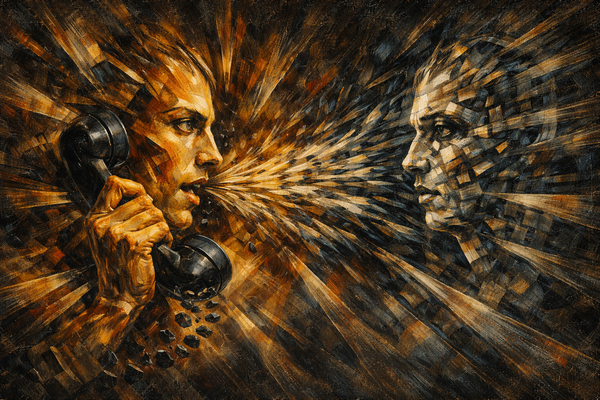
Something shifts in a conversation. The words are correct. The timing is right. But something at the edge of attention is telling you none of it is real. This series is about that moment, and why we learned to turn the alarm off.

Essay One of The Valley of False Signals series
Listen to this essay on Substack.
There is a moment, and you will recognize it, when something shifts in a conversation. The person across from you is saying all the right things. The words are correct. The timing is right. But something, some faint sourceless pressure at the edge of attention, is telling you that none of it is real.
You probably dismiss it. You tell yourself you're being paranoid. You remind yourself that first impressions are unreliable, that mature judgment requires patience, that it would be rude and intellectually dishonest to condemn someone on nothing more than a feeling you cannot name. The feeling recedes. The conversation continues.
That moment is what this series of essays is about.
Not the feeling, though we will examine the feeling closely, because it turns out to be far more sophisticated than we typically credit. What this series is about is what happens after the feeling: the mechanism by which a genuine, often accurate signal is overridden, discredited, and filed away as social noise. And why that mechanism (the suppression of a valid alarm) is, I will argue, the central vulnerability running through cybersecurity, institutional governance, and the architecture of trust itself.
A Roboticist's Observation
In 1970, a Japanese robotics professor named Masahiro Mori published a short essay in an engineering journal. It was not a scientific paper in the rigorous sense; Mori himself later acknowledged it was more of a practical guideline than a formal hypothesis. But the observation it contained would propagate through robotics, psychology, film theory, and eventually into the cultural nervous system of the early twenty-first century.
Mori had noticed something strange about the way people responded to increasingly humanlike machines. As a robot became more human in appearance, as it acquired a face, then expressive features, then realistic skin, people's emotional responses generally warmed. This was expected. What was not expected was that this progression had a cliff in it.
At a certain point (not when the robot was obviously mechanical, and not when it was indistinguishable from human, but at the liminal region between) something curdled. The emotional response reversed. People who had been warming to the robot now found it disturbing, unsettling, wrong. Mori called this region bukimi no tani: the valley of eeriness, rendered into English as the uncanny valley.
The shape of the phenomenon, plotted on a graph, gives the metaphor its name: a steep climb in affinity as human-likeness increases, a sudden plunge into repulsion as it approaches but fails to reach genuine humanity, and then, in theory, a recovery as the entity becomes genuinely indistinguishable.
For decades, the uncanny valley was discussed primarily as a design problem. The Polar Express fell in. Early deepfakes fell in. Hiroshi Ishiguro's android replicas of himself produced in observers a reaction that is difficult to name precisely: the sense of looking at a body before the soul had fully arrived. The conversation stayed there. The uncanny valley as aesthetic problem, as design challenge. How to cross the valley, how to avoid it, how to render the simulation perfect enough that the alarm doesn't fire.
But the alarm itself has received far less attention. What it actually is. Why it fires. What it is detecting. And what happens when it is suppressed.
The intellectual lineage is older than the design conversation typically acknowledges. In 1906, the psychologist Ernst Jentsch published an essay locating the uncanny in intellectual uncertainty: the doubt whether an apparently animate being is really alive, or whether a lifeless object might not be in fact animate. Jentsch's uncanny was an epistemological condition, the feeling produced when you cannot determine whether what you are encountering is what it appears to be. Freud took up the theme in 1919 and reframed it as repression, but Jentsch's earlier, sharper account is more useful here. His uncanny is about epistemic failure, not repressed desires: the moment when your model of what you are encountering will not settle, when the entity will not resolve into a stable category. That is what Mori was mapping, without quite having the language for it.
Charles Darwin, interestingly, documented a version of this experience before either Jentsch or Mori. Watching the face of a trigonocephalous viper, he described a "repulsive aspect" that he attributed to the features being placed in positions somewhat proportional to the human face. A coincidence of geometry, producing a near-human pattern, triggering the coherence check. The brain fired the alarm. I find myself returning to this image because of what it implies about the mechanism's age. Older than language, older than culture, older possibly than the specific social environments that generate the suppression pressure that keeps the alarm from acting.
What the Alarm Is Actually Measuring
The popular account of the uncanny valley runs like this: we have evolved to recognize human faces and bodies with extraordinary precision, and when something approximates human form but gets details wrong (when the eye movement is slightly off, when the smile is a beat late, when the skin texture is just slightly wrong) our finely tuned perceptual system flags the mismatch. The revulsion is a kind of perceptual static, the cognitive equivalent of a note played slightly flat.
This account is not wrong, but it is too shallow. It treats the uncanny valley as a perceptual phenomenon, about what we see, rather than as an epistemic phenomenon, about what we know.
The deeper account, supported by neuroimaging work done at UCSD and elsewhere, locates the mechanism not in perceptual processing but in prediction. The brain is not primarily a perception machine; it is a prediction machine. At every moment, it is running models of what should happen next: what this face should do, how this voice should sound, how this person's behavior should cohere with their apparent emotional state. When those predictions are confirmed, the processing is smooth, unremarkable, invisible. When they are violated, when what happens diverges from what was expected, the brain generates what neuroscientists call a prediction error, and it routes that error to attention.
The uncanny valley, in this account, operates at the level of prediction error rather than perception. And prediction errors are not just about what something looks like; they are about what something is. The brain is running a coherence check: do the signals this entity is producing match the underlying model? Does the emotion on this face correspond to an actual emotional state? Does the empathy this person is performing come from an actual affective source?
When the answer is no, when the brain detects that the signals and the source have come apart, the alarm fires.
I want to be careful about the weight I'm placing on this reframe, because it carries the rest of the series. But the implication is significant: the uncanny valley is fundamentally about authenticity, not appearance. The brain is trying to detect the difference between an entity that is producing signals organically, because it is what it signals itself to be, and an entity that is generating signals without the underlying reality those signals typically indicate.
Masahiro Mori was watching people react to robots. But what he was actually mapping was the detection range of a deeper system, one that asks, of any entity that presents itself as human: Is it, actually?
The First Extension: The Human Who Isn't Quite There
The uncanny valley effect occurs not just with machines, but with certain people. This observation has a clinical lineage that predates its connection to Mori's work. Hervey Cleckley, writing in the 1940s, described the psychopath's presentation as a "mask of sanity," a performance of normalcy so convincing that the gap between the performance and the absent interior could only be detected as a felt wrongness by those in sustained contact. Robert Hare's research on psychopathy documented the same structure from the behavioral side: the superficial charm, the glib affect, the capacity to read others with precision while remaining affectively disengaged. Sam Vaknin, writing more recently about narcissistic and psychopathic personality disorders, made the connection to the uncanny valley explicit and gave the mechanism its most useful name.
Vaknin's formulation begins with an observation about mimicry. Narcissists and psychopaths, he argues, do not experience emotions in the same register as neurotypical people. They are cognitively sophisticated, often extraordinarily so, capable of modeling the emotional states of others with great precision, reading behavioral cues with what he calls "X-ray vision," anticipating needs and vulnerabilities with a clarity that mimics deep understanding. But the cognitive model and the affective experience are severed. They understand what empathy looks like. They do not feel it. They can produce the outputs of emotional connection without any of the inputs.
Vaknin calls this "cold empathy." The cognitive element of empathy is present; its emotional correlate is not. The result is a performance that is, in many circumstances, indistinguishable from the genuine article, but which, under careful observation, or simply under the unreasoning attention of an alerted nervous system, produces the same response as the android in the uncanny valley.
Those who have encountered such people often report a version of the same experience: an initial impression of charisma, attentiveness, almost uncanny perceptiveness. Then, gradually or suddenly, a wrongness. Something not quite locatable, not quite nameable, but insistent. The smile arrives a moment before the emotion it is supposed to express. The empathy is there, but it is aimed, like a tool. The interest is genuine, but it is extractive. The connection is almost real, and it is precisely the almost that triggers the alarm.
The brain is running its coherence check: do the signals match the source? And what it finds, in the narcissist or the psychopath, is what it finds in the android. Signals without the substrate they purport to originate from. The alarm fires.
I should be careful with this parallel, because it risks collapsing a clinical category into a metaphor. The clinical research on psychopathy and narcissistic personality, from Cleckley through Hare to Vaknin, documents something specific: a structural identity between two forms of the uncanny experience. The prediction error mechanism does not distinguish between silicon and neurology when the relevant question (is this entity what it is signaling itself to be?) returns a negative. It produces the same output: discomfort, wariness, a nameless wrongness, the impulse to distance. Whether the analogy holds all the way down is a question I cannot fully resolve here, but the structural correspondence is robust enough to carry what follows.
What matters for our purposes is not the psychology of narcissism per se (the clinical territory is extensive and well-mapped) but the structure of the detection mechanism and, critically, what happens to it under social pressure.
The Suppression Problem
Here is where the standard account of the uncanny valley ends, and where this series begins.
The alarm fires. You feel it. Something is off about this person, this message, this institution, this system. The signals are there, the performance is smooth, but the coherence check is returning a failure. The prediction error is registered. The alarm sounds.
And then you turn it off.
You turn it off because the social environment you are operating in generates its own pressure, a pressure that says: this kind of alarm is the product of bias, of unfairness, of rash judgment. Good judgment is patient judgment. Trustworthy people trust. The alarm is telling you something is wrong; your socialization is telling you that naming that wrongness is itself wrong.
Research on first impressions of narcissists documents this dynamic in clinical detail. In a series of studies by Mitja Back and colleagues, people who viewed brief video recordings of interactions involving a narcissist could identify the narcissist with accuracy significantly above chance; the signal is real, the detection is working. But in face-to-face encounters, those same people tend to form positive impressions after a brief interaction. The alarm fires. Then it is overridden. Because in a social context, acting on an unverifiable gut feeling about someone is considered socially impermissible. We give people the benefit of the doubt. We remind ourselves that first impressions are unreliable. We tell ourselves we are being paranoid.
The narcissist and the psychopath understand this mechanism implicitly, and they exploit it with great precision. The initial encounter is designed to produce warmth and connection sufficient to make the alarm feel like an anomaly. The social context (a professional meeting, a job interview, a first date) already carries with it strong norms against the expression of unverifiable suspicion. The combination of a convincing performance and a social environment hostile to unjustified distrust creates a window of suppression, and into that window the skilled manipulator walks.
This is the structure that recurs throughout this series, applied at increasingly large scales. The narcissist exploiting the social prohibition against naming what the alarm is detecting. The social engineer and the insider threat exploiting professional norms that suppress security concerns in favor of operational efficiency. The governance framework performing accountability in ways that trigger suppression in the very regulators and boards who would feel socially inappropriate naming the wrongness they sense. And finally, at the civilizational level, the collapse of authentication itself: signals so perfectly fabricated that the alarm stops having a reliable object to fire at. Each scale is different, and later essays will examine them separately, but the underlying structure is the same: a valid alarm, a suppression mechanism, and a vulnerability that lives in the gap between them.
The Brain That Built the Alarm
The neuroscience supporting this interpretation is still developing, but it is converging on a coherent picture.
fMRI studies examining responses to humanoid robots, androids, and computer-generated faces have consistently found that what activates when someone enters the uncanny valley is not the perceptual processing regions we might expect (the areas responsible for face recognition, say) but regions associated with prediction and anomaly detection. Ayşe Pınar Saygın and her colleagues at UCSD described it clearly: "The brain doesn't seem selectively tuned to either biological appearance or biological motion per se. What it seems to be doing is looking for its expectations to be met, for appearance and motion to be congruent."
The brain registers not the appearance of the entity, and not its behavior, but the relationship between them. Incongruence is what triggers the alarm: when appearance predicts one kind of behavior and the entity produces another, when the face says empathy and the eyes are doing something else, when the voice says warmth and the rhythm is slightly off. Research by Mathur and Reichling showed that this registers at the level of action, not just feeling: people were less willing to entrust money to highly humanlike-but-imperfect robots in economic games designed to measure implicit trust. A 2022 study examining 251 real-world robots found the phenomenon more structurally complex than Mori's original graph implied, with the brain running multiple simultaneous coherence checks and the alarm firing from more than one kind of incongruence.
The evolutionary logic is not difficult to see. Social species depend on the ability to correctly classify conspecifics: is this individual cooperative or defecting? Is this person's presentation of their emotional state genuine or strategic? An organism that cannot detect simulated cooperation will be exploited by defectors. An organism that takes all signals at face value will, in a world that contains sophisticated mimics, die. The uncanny valley, in this frame, is the detection range of an anti-deception system, sensitive to the things that are hardest to fake: the precise timing of emotional responses, the micro-expressions that precede verbal statements by milliseconds, the coherence between what a face does and what a voice does and what a body does.
This is why the effect is more pronounced for moving entities than for static ones. A photograph of an android may not trigger the alarm; a video of that android's facial responses in conversation almost certainly will. The detection system watches the face over time, checking the timing, checking the coherence, checking the relationship between what the face does and what it is responding to.
The system has a known weakness: it can be defeated by sufficiently perfect mimicry. If the simulation of authenticity is close enough to the real thing that the prediction errors are too small to cross the alarm threshold, the detection fails. This is Mori's theoretical recovery on the far side of the valley: the entity so humanlike that it stops triggering alarm. But that theoretical recovery has a practical catch, because in the real world, as we will examine in later essays, sufficiently perfect mimicry is now possible, and achievable at scale, and the detection system was never designed to cope with that.
What Is Being Detected: The Signal/Source Split
To understand why this matters for cybersecurity and governance (and it matters enormously) we need to be precise about what the uncanny valley alarm is actually detecting.
I want to propose a formulation: the alarm fires when the brain detects a split between signal and source. When an entity is producing outputs (emotional expressions, behavioral patterns, institutional declarations, security certifications, authenticity signals) that are not causally connected to the substrates that would normally produce those outputs.
The android produces facial expressions that are not caused by an emotional state; the narcissist produces empathy without genuine affective resonance; the governance framework produces accountability declarations that are not caused by genuine accountability practices. And the deepfake voice says "transfer the funds, I'm authorizing it," but those words are not caused by the executive whose voice is being simulated. In each case, the output is present but its originating substrate is missing.
The signal is present in every case. The source is absent, or has been severed from the signal, or has been replaced with something that produces the signal synthetically. The signal says: trust me, I am what I appear to be. The source says: actually no.
The uncanny valley alarm is a split-detector. Its job is to identify cases where signals and sources have come apart. And its core insight, which is also its core vulnerability, is that when this split is small enough, the detection requires feeling rather than reasoning. The gap between signal and source, in a well-executed performance of authenticity, is not large enough to be articulated. It can only be sensed.
This is why the social suppression mechanism is so dangerous: it targets exactly the class of knowledge that a well-executed deception leaves. You cannot prove, in the moment, that the feeling you have is accurate. The performance is convincing. The reasons to trust are articulable; the reasons to distrust are not. And in any social or professional context that privileges articulable reasons over inarticulate feeling, which is most social and professional contexts, the alarm will be overridden.
The split detector fires. Social convention silences it. The deception proceeds.
The Series Ahead
This essay has been deliberate about staying at the level of mechanism. The essays that follow trace the alarm, and its suppression, through four escalating scales: the individual attacker who weaponizes cold empathy, the synthetic media that crosses the valley entirely, the governance framework that performs accountability without producing it, and the structural question of whether detection systems can be designed that are immune to social override.
Why Now
One final thing deserves to be said in this opening essay, because it establishes the urgency that runs through everything that follows.
The alarm was calibrated by evolution for a specific environment: face-to-face social interaction, at the scale of bands and villages and small networks of known individuals, where the entities presenting themselves as human were overwhelmingly genuine. The system is exquisitely sensitive to the kinds of deception available in that environment. That is not the environment we are operating in. We are operating in an environment where voices can be synthesized in real time, where organizational accountability can be documented without being practiced, where social engineers operating from other continents can research a target well enough to fool a colleague of ten years, and where the social norms that generate suppression pressure have been calibrated for a world where the threats the alarm was detecting were far rarer, and far less capable, than they are today.
The alarm was built for a world that no longer exists. The suppression mechanism was calibrated for a world where the cost of suppressing a false alarm was low. Neither of those things is still true.
In earlier essays, I have examined pieces of this problem from different angles. Reality Hunger traced the epistemological crisis that synthetic media creates for judgment and discernment. The Compound Vulnerability examined specific systemic failures, Salt Typhoon and the erosion of federal access controls, as case studies in how institutional defenses collapse under sustained adversarial pressure. This series completes the arc. It examines the detection mechanism that should have caught what those earlier essays described, the alarm that evolved to identify when signals and sources have come apart, and asks why, at every scale from the personal to the civilizational, we have learned to turn it off.
The alarm is still working. For now, in most contexts, it still fires when it should. The problem is not the alarm. The problem is us: the learned behavior, the professional norm, the social convention, the institutional culture that has taught us that turning off the alarm is a form of wisdom.
I want to trace the cost of that teaching. I have spent thirty years in cybersecurity governance watching the suppression mechanism operate, and I have not always been on the right side of it. I have sat in rooms where the alarm was firing and said nothing, because the meeting was running long, because the vendor relationship was important, because the evidence I had was a feeling and the evidence against me was a signed audit report. The cost of that silence is part of what this series is about.
In the individual who overrides their instinct about the person who is performing all the right signals while producing none of the substance. In the enterprise that overrides its security analyst's concern because the vendor is trusted and the contract is signed. In the board that overrides the CISO's alarm about a governance gap because the framework says compliant and the auditor says clean. In the civilization that has built its infrastructure of trust on a detection system it has simultaneously spent decades learning to suppress.
This series is about what happens when a species that evolved an alarm for inauthenticity decides, with great sophistication and considerable social enforcement, to turn it off.
Next: Essay Two — Cold Empathy at Scale. On social engineering, the attacker as narcissist, and why security awareness training has been solving the wrong problem for thirty years.
Sources
The Uncanny Valley
Mori, M. (1970). Bukimi no tani [The uncanny valley]. Energy, 7(4), 33–35. (In Japanese.) English translation: Mori, M., MacDorman, K.F., & Kageki, N. (2012). The uncanny valley [From the field]. IEEE Robotics & Automation Magazine, 19(2), 98–100.
Intellectual Lineage
Jentsch, E. (1906). Zur Psychologie des Unheimlichen [On the psychology of the uncanny]. Psychiatrisch-Neurologische Wochenschrift, 8(22), 195–198; 8(23), 203–205. English translation in: Collins, J. & Jervis, J. (Eds.) (2008). Uncanny Modernity: Cultural Theories, Modern Anxieties (pp. 216–228). Palgrave Macmillan.
Freud, S. (1919). Das Unheimliche [The uncanny]. Imago, 5(5–6), 297–324. English translation in: The Standard Edition of the Complete Psychological Works of Sigmund Freud, vol. 17, trans. James Strachey (London: Hogarth, 1955), 217–256.
Darwin, C. (1872). The Expression of the Emotions in Man and Animals. John Murray.
Neuroscience of the Uncanny Valley
Saygın, A.P., Chaminade, T., Ishiguro, H., Driver, J., & Frith, C. (2012). The thing that should not be: Predictive coding and the uncanny valley in perceiving human and humanoid robot actions. Social Cognitive and Affective Neuroscience, 7(4), 413–422.
Mathur, M.B. & Reichling, D.B. (2016). Navigating a social world with robot partners: A quantitative cartography of the uncanny valley. Cognition, 146, 22–32.
Kim, B., de Visser, E.J., & Phillips, E. (2022). Two uncanny valleys: Re-evaluating the uncanny valley across the full spectrum of real-world human-like robots. Computers in Human Behavior, 135, 107340.
Psychopathy, Narcissism, and Cold Empathy
Cleckley, H. (1941). The Mask of Sanity: An Attempt to Clarify Some Issues About the So-Called Psychopathic Personality. C.V. Mosby. (Subsequent editions: 1950, 1955, 1964, 1976, 1988.)
Hare, R.D. (1993). Without Conscience: The Disturbing World of the Psychopaths Among Us. Pocket Books/Simon & Schuster. See also: Hare, R.D. (2003). Manual for the Revised Psychopathy Checklist (2nd ed.). Multi-Health Systems.
Vaknin, S. (2003). Malignant Self-Love: Narcissism Revisited. Narcissus Publishing. See also Vaknin's published lectures and writings on cold empathy and the narcissistic uncanny valley.
Narcissist Detection and First Impressions
Back, M.D., Schmukle, S.C., & Egloff, B. (2010). Why are narcissists so charming at first sight? Decoding the narcissism–popularity link at zero acquaintance. Journal of Personality and Social Psychology, 98(1), 132–145.
Robotics and Android Design
Ishiguro, H. (2006). Android science: Conscious and subconscious recognition. Connection Science, 18(4), 319–332. See also the Geminoid series of android replicas developed at Osaka University.
Cross-Series References
Brondani, M. Reality Hunger (essay series). Published at marcobrondani.com (link to first essay in series).
Brondani, M. The Compound Vulnerability (essay series). Published at marcobrondani.com (link to first essay in series).