
The Return of the Generalist
What survives the AI era is not the broad mind, but the mind that has been deep once.

In brief
The popular thesis, that AI commoditised expertise so the broad generalist wins, is almost true, and the almost is where it fails: fluency on tap devalues the shallow generalist as fast as depth on tap devalues the specialist.
The mind whose value is climbing is a third kind. It has gone deep in one thing at least once, deep enough to know that every serious field hides an architecture, and to feel when that architecture is missing.
Chess supplies the mechanism. In the Chase and Simon studies of 1973, masters rebuilt real board positions almost perfectly and random ones no better than novices: they were seeing structure, not remembering harder. Structure has no signature to anyone who cannot already see it.
What carries across fields is not the expertise itself but the knowledge that depth exists at all, which leaves a lasting suspicion of fluent surfaces.
That sets up a verification problem with no clean fix. A model now produces a flawless surface in any voice, so the old signals of credential, polish, and volume sort wrong. The workable move is to watch how someone fails at the edge of their competence: confident fluent error is the counterfeit, visible recalibration is the real thing.
Generalists are having a moment. The thesis is everywhere now: artificial intelligence has commoditised narrow expertise, so the broad mind, the polymath, the synthesizer across domains, is the mind that wins. The specialist is finished. The generalist is back. Panels are convened on this. Essays are written on it. The thesis has the comfortable property of being almost true.
Almost true, in a way that hides the actual problem. If the standard story were right, value would be sliding from the specialist toward the broad mind. It is. But the broad mind is being undercut at the same time, and faster, because anyone with a chatbot now produces fluent cross-domain takes on any subject in thirty seconds. The synthesizer who knew a little about a lot was never cheap to maintain in a human. The same product is now free in a model. The shallow generalist has been quietly devalued at exactly the same moment as the specialist, and has noticed it less.
That leaves the question open. If the specialist is being undercut by depth-on-tap, and the broad mind is being undercut by fluency-on-tap, then a third kind of mind must be the one whose value is rising. What kind?
Leave the topic of AI for a few paragraphs. The clearest demonstration of depth concerns chess and is half a century old.
The studies ran from the 1940s through the early 1970s, refined most sharply by William Chase and Herbert Simon in 1973. A chess master and a chess novice were shown the same arrangement of pieces on a board for five seconds, then asked to reconstruct it on an empty board. The master reproduced the position almost perfectly. The novice could not. This is what most people would expect, and on its own it shows nothing interesting; the master, after all, is the master.
Then the control. The researchers showed both subjects pieces arranged randomly, in configurations that could not have arisen in any real game. The master’s advantage nearly disappeared. Master and novice were now roughly equivalent at the task.
The result is famous in the perception literature, and its interpretation has held up across half a century of replication. The master is not remembering harder, and not seeing faster. The master is seeing meaning where the novice is seeing only pieces. A real game position contains structure: threats, defended squares, latent patterns. The master perceives that structure directly, the way someone fluent in a language perceives a sentence rather than a sequence of words. When the structure is absent, as in a random arrangement, the master has nothing to perceive that the novice does not.
That is the first half of the result.
The second half is less often cited: the novice watching the master cannot perceive that anything extra is being seen. From outside, the master appears to be looking the way anyone looks.
Depth has no visible signature to the untrained eye.
Chess expertise does not transfer. Grandmasters are not generally smarter than other people of comparable IQ; their pattern recognition is exquisite inside chess and ordinary outside it. Decades of attempts to show that chess training makes children better at mathematics, or planning, or anything else, have produced equivocal results at best. The chunks the master sees in a real game are precisely the chunks of that game. Take the master out of chess and you take away the perception.
So if the value of having gone deep into chess does not transfer, the use of chess for an essay about generalism appears to fall apart.
What transfers is not the chunks but the knowledge that chunks exist. Having gone deep into one thing once, you have learned in your body that every serious domain contains a hidden architecture invisible from outside. The architecture is different in every domain, and so the specific perception cannot be carried across. What is portable is the knowledge that such architectures exist, that they take years to acquire, and the texture of what real understanding feels like. That set of three becomes a permanent suspicion of surfaces.
The person who has never been deep in anything lacks the suspicion. Every domain looks shallow from outside, including the ones that are not, and they have no internal record of the gap between what a field looks like to the layperson and what the field is. So they cannot calibrate. They cannot tell the fluent surface from the load-bearing depth, because they have never personally seen the difference even once. That is exactly the cognitive position AI’s fluent shallowness now exploits at scale.
The valuable mind in the era of cheap fluency is not the broad mind, and not the deep specialist. It is the mind that has been deep in something once, deep enough to know that depth exists and what its absence looks like.
The same recognition appears in every domain where someone has been deep and someone else has not.
In medicine, the experienced diagnostician’s “something is off” before the labs return is not mysticism but what the chess result names: pattern recognition built from thousands of cases, the structure clinicians call illness scripts. The diagnostician is not seeing harder but seeing the meaningful structure of the presentation, the way a chess master sees a position. A medical student watching that diagnostician work cannot perceive that anything extra is being seen. The diagnostician appears to be looking the way the student looks. That is the same invisibility.
In music, the trained ear hears a wrong note in a passage where the layperson hears music. The disagreement between the trained ear and the lay ear is not about taste but about one party perceiving structure where the other perceives only surface, and neither party can fully explain the gap to the other. The performer who stops a recording at one phrase, because of a single missed inflection, is doing what the chess master does in a different register.
Biology supplies the cautionary case, and supplies the link to the present moment. Convergent evolution is in some sense nature’s own analogy engine: the eye evolved independently dozens of times, and the structural similarity across phyla is one of the most beautiful patterns in the discipline. But Stephen Jay Gould and Richard Lewontin’s 1979 paper The Spandrels of San Marco and the Panglossian Paradigm identified the danger of fluency in this register. Many evolutionary explanations that sounded like depth, they argued, were in fact just-so stories: adaptationist tales told in a confident voice, often inventive and elegant, frequently load-free. The adaptationist narrative was the pre-AI counterfeit of cross-domain insight. It was produced in a competent generalist’s voice. It performed brilliantly at conferences. Much of it turned out, on examination, not to bear weight.
In literary translation, the AI era has produced a natural experiment. Commercial translation has collapsed into low-paid post-editing of machine output; literary translation, paradoxically, has become more visible than ever. Translators’ names appear on covers. Prizes are awarded to them. The same tool that hollowed one form of the craft elevated the other. The reason is the same reason as everything else in this essay. Commercial translation rewarded fluency, and fluency is now free. Literary translation requires the judgment of which of a hundred possible English sentences holds the load of the German one. That judgment is not fluent but calibrated. The market sorted itself.
In each case the practitioner perceives meaning where the layperson perceives only surface. In each case the layperson cannot detect that anything extra is being perceived. And in each case, now, AI produces a fluent surface so convincing that the layperson can no longer tell the practitioner’s calibrated output from the model’s confident counterfeit. The calibrated mind can still tell them apart, the mind that has never been deep cannot.
The figure being described is not new, even if its current moment is. The generalist has died and come back several times in the history of the modern mind, and each return has been to a different creature.
Thomas Young is the cleanest case from the period before specialization closed in. He was an English physician of the early 1800s. He did the wave theory of light, ran the double-slit experiment, and decoded a substantial portion of the demotic script on the Rosetta Stone, alongside serious contributions to materials science, music theory, and the physiology of vision. Andrew Robinson titled his 2006 biography of Young The Last Man Who Knew Everything. The phrase is a slight overstatement, and Young is not actually the last; but the title named a real transition. Within fifty years of Young’s death, the configuration of intellectual life that had supported him had ended.
Goethe is the parallel case in the literary tradition. He coined the word morphology, did serious comparative work on plant form, and developed a theory of colour. The colour theory was wrong about the physics, in ways Newton had already settled, but right about the perception of colour in ways that took another century to recognise. Goethe was a polymath in a register the professional sciences would soon stop tolerating.
The institution that closed the polymath role was the nineteenth-century German research university. Wilhelm von Humboldt’s model, with its seminar method, its specialised faculty, and its requirement that knowledge be produced inside a discipline, made the polymath structurally obsolete. By 1900 the Renaissance ideal had been replaced by the modern researcher, and the word amateur had completed its slide from praise to insult. The polymath retreated into the disreputable category of the dilettante and stayed there for most of the twentieth century.
A partial revival arrived in the 2000s under the name T-shaped. The framing was a deep specialist who also worked usefully across adjacent fields, and it was a useful idea, but it remained a hybrid description. The T was still rooted in the specialist as the load-bearing element. The breadth was decoration.
The empirical revival is more recent, and more careful. Philip Tetlock’s research on political and economic forecasting was summarised in his 2005 book Expert Political Judgment and extended in Superforecasting with Dan Gardner in 2015. Across decades of records, foxes consistently outperform hedgehogs at prediction. The terminology is older. Isaiah Berlin took it from a fragment of the Greek poet Archilochus, in his 1953 essay The Hedgehog and the Fox, to distinguish minds that know one big thing from minds that know many things. Tetlock found that Berlin’s foxes won.
The complication, which the popular reception of Tetlock’s work tends to skip, is that his winning foxes were not merely broad. They were broad and calibrated, updating quickly on new evidence, holding their views loosely, and reporting lower confidence even when they were right. A naïve fox, broad and uncalibrated, loses to a competent hedgehog. The variable was never breadth.
Each return of the generalist, then, has been to a different creature. The 2026 version is a new creature again. It is defined not by knowing many things (the model knows more) but by being able to judge across many things, because real depth has been experienced at least once. The figure does not yet have a settled name.
The trouble is that the mind being described is not only valuable but harder to detect than it has ever been.
The reason is the same as the structure of the chess result. Depth is invisible from outside. To anyone who lacks depth themselves, depth has no detectable signature. And we have just built a tool that produces a flawless surface on demand, in any domain, in any voice.
The adaptationist just-so story was the pre-AI version of fluent cross-domain insight without an anchor: confident, plausible, often load-free. It took the field of evolutionary biology a generation to dislodge the worst examples. The stories sounded like understanding. To anyone outside the specific area, and to many inside it, there was no visible difference between an adaptationist hypothesis that held under examination and one that did not. The difference was visible only on the load test, and the load test took years.
AI now produces adaptationist storytelling, in every domain at once, on request. It is exceptionally good at it. The output is fluent, integrative, cross-referenced, voiced. It can be made to sound like any school of thought you name. To the reader who has not personally been deep in the domain it is discussing, it is indistinguishable from real synthesis. On every legible metric of writing quality, it outperforms the calibrated original. The reason is structural. Every legible metric of writing quality was developed in an era when fluency was a costly signal of competence. It no longer is.
This produces a verification problem that does not have a clean solution. The institutions that need the calibrated mind cannot easily find it, because the signals they were built to read have been imitable for two years and counting. The calibrated mind cannot easily prove itself by output alone, because the output is what gets imitated first. The mind that has been deep once knows that something is wrong with most of what it now reads online. But it cannot defend that judgment to anyone who has not been deep themselves. The judgment is precisely what they lack the prior to receive.
The problem will not solve itself. It is structural, not transitional. The chess result predicted it half a century ago without naming it: depth is invisible to those who lack it. We have now built a machine that exploits exactly that invisibility, at speed, in language, everywhere, for free.
The honest position from here is open. I do not know how this gets resolved at the level of public discourse. I have a working answer for how it gets resolved inside institutions. The discourse-level problem may not be solvable at all, and anyone who claims a clean answer for it is probably overconfident.
The position is harder than it has been, then, but not hopeless. The work remaining is locating and trusting the calibrated mind without the tools that used to do it for us.
The institutional part is concrete. The structures that currently sort by credential, by writing quality, by polish, by output volume, will all increasingly sort wrong. They were calibrated for the era in which fluency was a costly signal of competence. They have not yet been adjusted for the era in which it is not. That work is doable. People who already do this well, in my experience and in the experience of people I trust to know, do roughly the same thing. They put candidates into problems adjacent to their depth, in domains the candidate has not specifically prepared for. Then they watch how the candidate handles being out of their depth. The way someone errs at the edge of their competence is what reveals their calibration. Confident, fluent errors are the counterfeit’s signature. Wrong moves followed by visible recalibration are the real thing. That is the behaviour depth teaches.
The personal part is shorter, and it has not changed in centuries. There is exactly one route to becoming this kind of mind. Pick something. Go deep into it. Stay deep until the chunks form, until the field has internal texture, until you have felt, once, what understanding feels like from the inside. The specific thing does not matter as much as the depth of the going. The craft can be jazz piano, synthetic chemistry, late Roman history, carpentry, or differential geometry; what matters is that it was taken seriously enough to leave a mark. The mind that has been the real thing in any one of these carries the standard out into every other domain it encounters. After that the rest is portable. Not the chunks. The suspicion. The standard.
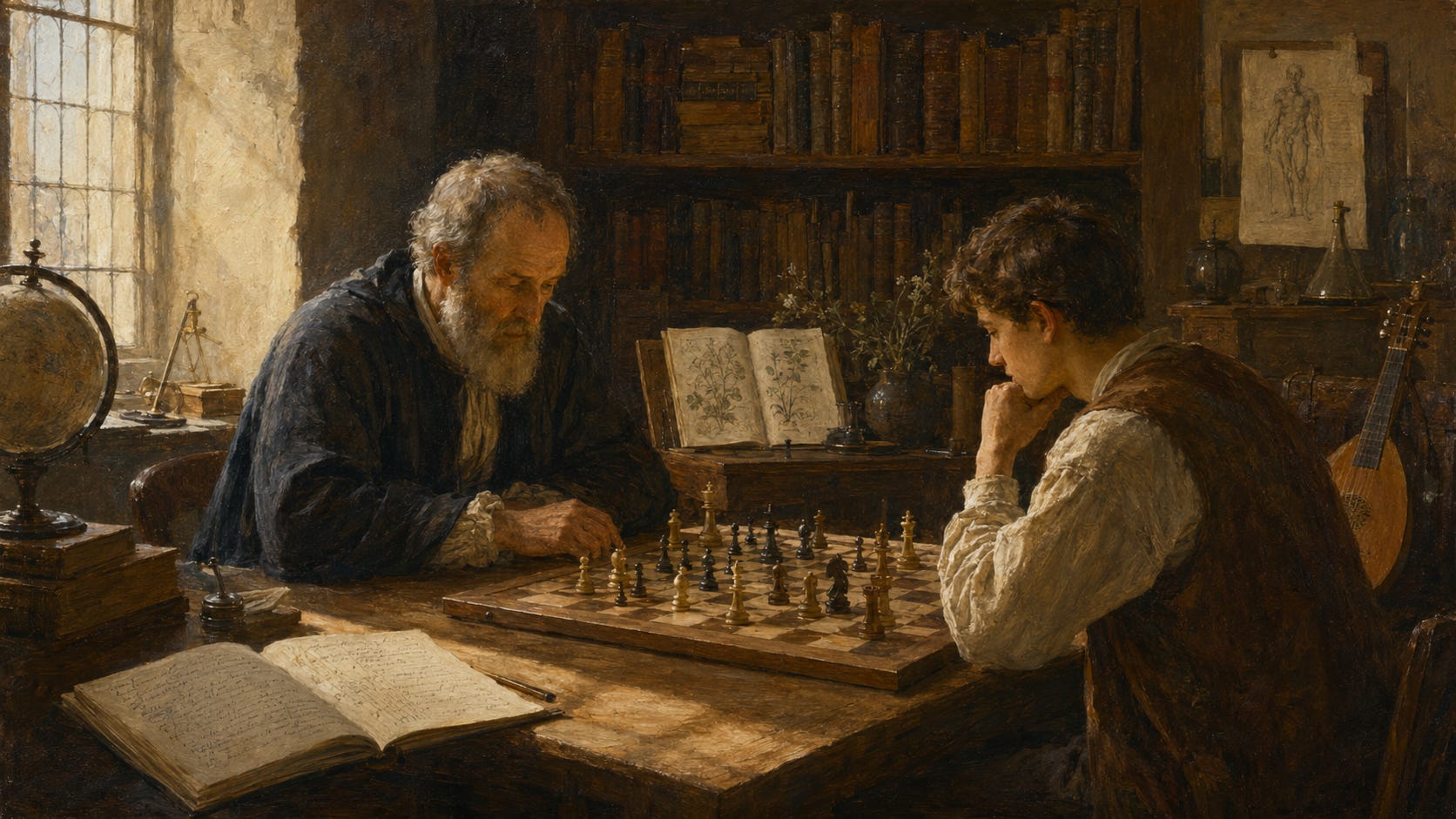
One last picture. A chess master sits beside a novice in front of a real board. The master sees a position, sees a threat, sees the move four ahead that resolves everything. The novice sees only pieces. The master cannot fully explain to the novice why the move is right. Explaining would require the novice to have already done the work that produced the perception. The novice sees the master looking at the board and concludes, reasonably, that the master is looking at the board.
That is the situation every reader of this essay is now in, in domains other than their own. Most consequential decisions of the next two decades will be made by minds judging across domains where they have not been deep. The question is the same for an institution, a country, or a person: whether the mechanism exists to find and trust the people who have been deep enough to see what the layperson cannot. Not the mechanism for trusting the AI, but the mechanism for trusting the humans who will have to use it.
Depth is invisible from outside. The discipline is to keep looking anyway.
Sources
Berlin, Isaiah. The Hedgehog and the Fox: An Essay on Tolstoy’s View of History. London: Weidenfeld & Nicolson, 1953.
Chase, William G., and Herbert A. Simon. “Perception in Chess.” Cognitive Psychology 4, no. 1 (1973): 55–81.
De Groot, Adriaan D. Thought and Choice in Chess. The Hague: Mouton, 1965. Originally published in Dutch as Het denken van den schaker (Amsterdam: Noord-Hollandsche, 1946).
Goethe, Johann Wolfgang von. Versuch die Metamorphose der Pflanzen zu erklären. Gotha: Ettinger, 1790.
Goethe, Johann Wolfgang von. Zur Farbenlehre. Tübingen: Cotta, 1810.
Gould, Stephen Jay, and Richard C. Lewontin. “The Spandrels of San Marco and the Panglossian Paradigm: A Critique of the Adaptationist Programme.” Proceedings of the Royal Society B 205, no. 1161 (1979): 581–598.
Robinson, Andrew. The Last Man Who Knew Everything: Thomas Young, the Anonymous Polymath Who Proved Newton Wrong, Explained How We See, Cured the Sick, and Deciphered the Rosetta Stone. New York: Pi Press, 2006.
Tetlock, Philip E. Expert Political Judgment: How Good Is It? How Can We Know? Princeton: Princeton University Press, 2005.
Tetlock, Philip E., and Dan Gardner. Superforecasting: The Art and Science of Prediction. New York: Crown, 2015.