
The Control Group
The absolutist frame is a zero-sum frame wearing a visionary's coat: the machine wins and the worker loses, or the worker wins and the machine is banished.

[ This piece extends “AI absolutism is breaking our brains,” The Guardian, 11 June 2026. Link below in Sources. ]
In brief
AI absolutism, the habit of holding the technology as either a coming golden age or the end of the human story, works as a sales posture more than an argument. Both poles come off the same production line: a market that is dazzled or terrified keeps buying, and stops asking the slower questions.
One test clears most of the noise. Ask whether a claim is about what the system does, which is bounded and testable, or what it is, which can only be believed or refused. Absolutism lives in the second kind while borrowing the credit of the first.
Flatten a reality into a destiny and you remove the control group, the comparison between what a system costs and what it returns. That is also what makes it impossible to govern.
The story we are sold is replacement, the machine taking the jobs. The one arriving is control: the worker watched, scored, paced, kept grateful for whatever work is left. Gig platforms were the proving ground, and the method is climbing into the offices.
So the quarrel we are handed is not the one underneath. Below human-against-machine runs depth against flattening, and the discipline is to step off the line and read each use on its own terms: what it does, to whom, at whose cost, for whose benefit.
I have spent thirty years inside the systems now being sold to the rest of the world as either salvation or ruin, and the thing that strikes me, every time, is never the technology itself: it is the certainty around it. Everyone is certain.
The people who build the machines are certain they will remake the world, the people who fear them are certain the world is ending, and the two certainties, though they point in opposite directions, have exactly the same shape. I have watched that shape arrive before. It came with the network, with the cloud, with the phone in every pocket, with every system I was ever asked to defend or to break open, and not one of them turned out to be the thing its loudest believers promised, in either direction.
The Guardian gave the posture its right name last week: AI absolutism, a way of holding the technology as a godlike force that will either deliver a golden age of productivity or close the human story for good. What the piece names, and what is worth sitting with longer than a column has room for, is that the contradiction between the two poles is not an accident, and not a sign of a debate still finding its feet: it is the product.
The apocalypse and the utopia come off the same line, built by the same people, for the same reason: a market that is either dazzled or terrified is a market that buys, and a public held at either extreme does not ask the slower questions. Suresh Naidu, the Columbia economist quoted in the piece, put the commercial logic without ornament: to justify the valuation, you point at a revenue stream large enough to look like it can eat all the work on the planet, so no investor can stand to miss it. The terror and the wonder are not competing messages but two faces of a single pitch.
There is a distinction I have come to rely on, because it dissolves most of this noise in one move, and I would rather hand it to you than describe it from a distance. Ask, of any claim made about these systems, a single question: is this a claim about what the system does, or about what the system is.
The two are confused constantly, and I have come to think the confusion is the whole game. “This model writes working code” is a claim about a capability: testable, bounded, measurable, and it will turn out solid in a few narrow domains and hollow in most of the others. “This model is intelligence” is a claim about a being, and it cannot be tested at all, only believed or refused.
Absolutism lives entirely in the second kind of claim while borrowing the credibility of the first. It takes a tool that demonstrably does a small set of things and reframes it as an entity with a destiny, and once a tool has been given a destiny, you are no longer permitted to evaluate it. You are only permitted to be for it or against it.
Run the test on the lines we have all been fed, and watch them come apart. When Jensen Huang of Nvidia says every job will be affected, immediately and unquestionably, he is making a does-claim inflated into an is-claim: the affecting is real and measurable, the immediacy and the unquestionability are theology bolted on top.
When Dario Amodei calls the technology not a substitute for specific jobs but a general labor substitute for humans, the sleight is in the word general: a thousand specific, testable substitutions, each of which would prove partial and uneven if you measured it, swept into a single claim no measurement could ever reach. And when Sam Altman conceded, months later, that he had expected far more elimination of entry-level white-collar work by now than had happened, he was not correcting a forecast: he was revealing it had never been one. A forecast can be wrong. A frame can only be maintained or abandoned, and he had begun, very slightly, to abandon his.
This matters far past the philosophy of it, because a reality flattened into a destiny is a reality you can no longer govern. The most honest sentence in the entire Guardian piece is Naidu’s other one: there is no control group.
He offered it as a caution about measurement, that we have no untouched population to set beside ourselves and compare. He is right. But the line cuts deeper than he let it: absolutism is the thing that removes the control group, because it forbids the comparison before it can begin. You cannot weigh what a system actually costs against what it actually returns when you have already decided, in advance and at volume, that it is either the future or the end of it.
Governance, the real kind, the unglamorous discipline I spent decades practicing, is nothing but the patient refusal of that flattening: the reconnaissance, the reading of the one situation in front of you, the insistence on knowing precisely what a thing does before you allow yourself to say what it means. Absolutism is the exact posture that makes this work impossible. I suspect that is part of why it is sold so hard.
And while the loud argument runs on between the two certainties, the quiet thing happens in the layer underneath. The story we are handed is replacement: the machine will take the jobs. The story actually arriving, in the systems I know from the inside, is not replacement but control: not the worker removed, but watched, scored, paced, and pressed to feel grateful for whatever work remains.
The gig platforms were the proving ground, the drivers and couriers managed by software that never sleeps and never explains itself, and the people who study labor expect the method to climb the ladder, out of the warehouses and the cars and into the offices that still assume they are too senior to be metered. This is the application absolutism keeps out of frame, because a public arguing about whether the machine is a god does not look down to see what it is being used to do to them.
So here is where the ground shifts, and I will admit it took me a long time to see. The fight we are told we are having is human against machine. We are not having that fight.
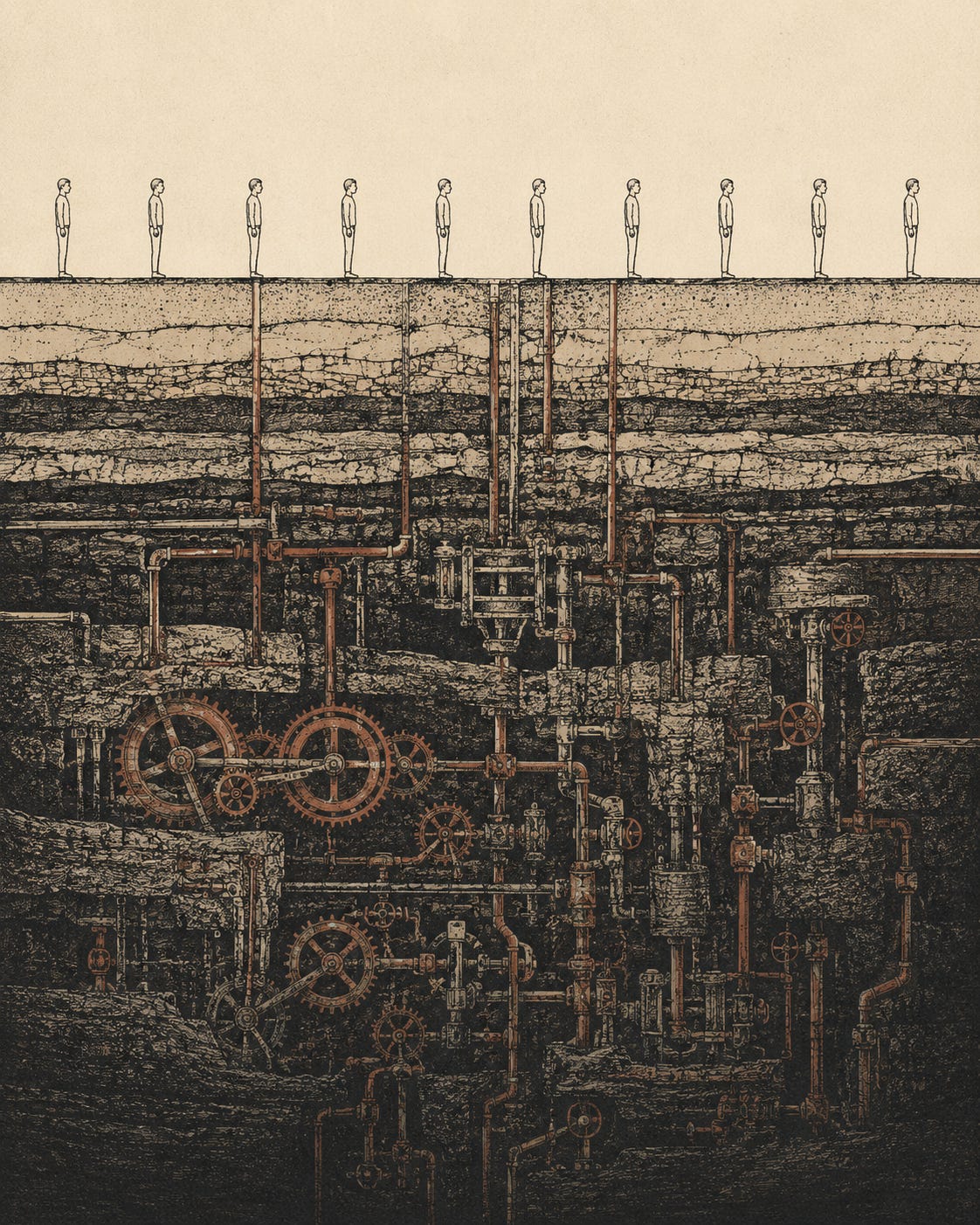
The fight underneath it, the one that actually settles anything, is depth against flattening: between a public kept on the top layer of a system it was never given the chance to understand, dazzled or frightened on command, and a public permitted to descend into the real complexity and act from down there, where the decisions actually live. Absolutism is not a position in the human-versus-machine argument but the instrument both sides are holding, pointed at the same place each time: at your capacity to hold the middle, to stay specific, to refuse the verdict long enough to see what is in front of you.
The Guardian lands, sensibly, on moderation, and I understand the pull of it. But moderation is not strong enough to carry the weight, because moderation only splits the difference: a calmer spot on the same line that runs from doom to rapture, the line itself left unquestioned. What is asked of us is to step off the line.
Not to use the technology a little, but to refuse the frame that says the only choice is how fervently to worship or how hard to flee. The harder discipline, and it is harder, is to read each use on its own terms, one at a time: what does this application do, and to whom, at whose cost, for whose benefit, and is that benefit shared with the people it touches or extracted from them. A model that helps a nurse learn faster and a model that helps a platform squeeze a courier are not the same event, and no single verdict about “AI” can hold both. That reading is slow, and unglamorous, and it will never fit in a headline or a valuation, which is the strongest recommendation it could have.
None of this is an argument against the technology. I use these systems; in the narrow places where they do what they actually do, I find them genuinely useful, and I have no patience for the abstinence the loudest critics keep mistaking for virtue. It is an argument against the certainty, in both of its costumes.
The certainty was never knowledge: it was a sedative, sold to keep us comfortable at the surface while the decisions that matter, about who is watched and who is paid and who is told to be grateful, were taken somewhere below us, in the layers we were made too dazzled or too frightened to read.
The Industrial Revolution is the comparison everyone reaches for now, and it is the right one, though almost never for the reason it is offered. It is offered as consolation: the machines came, it was hard for a season, and in the end it worked itself out. What that telling removes is the length of the season, the price of it, and the plain fact that nothing worked itself out on its own.
People made it work out, slowly, against real resistance, by organizing and insisting and declining to accept that the new arrangement was simply the weather. The wins took the better part of a century, and they were never handed down. They were taken, by people who refused to be certain about their own defeat.
That is the only future I am willing to be certain of: that it is not decided yet, and that the work of keeping it undecided, of staying specific and awake while the certainties are sold to us at full volume from both directions, belongs to us. It is not finished. It does not get to be put down.
Sources
“AI absolutism is breaking our brains,” The Guardian, 11 June 2026.
Marco Brondani, The Split Problem: Why We Cannot Tell If AI Is Conscious, Quill House Press, 2026.