
Care as a Discipline
How painting and celestial navigation survived automation.

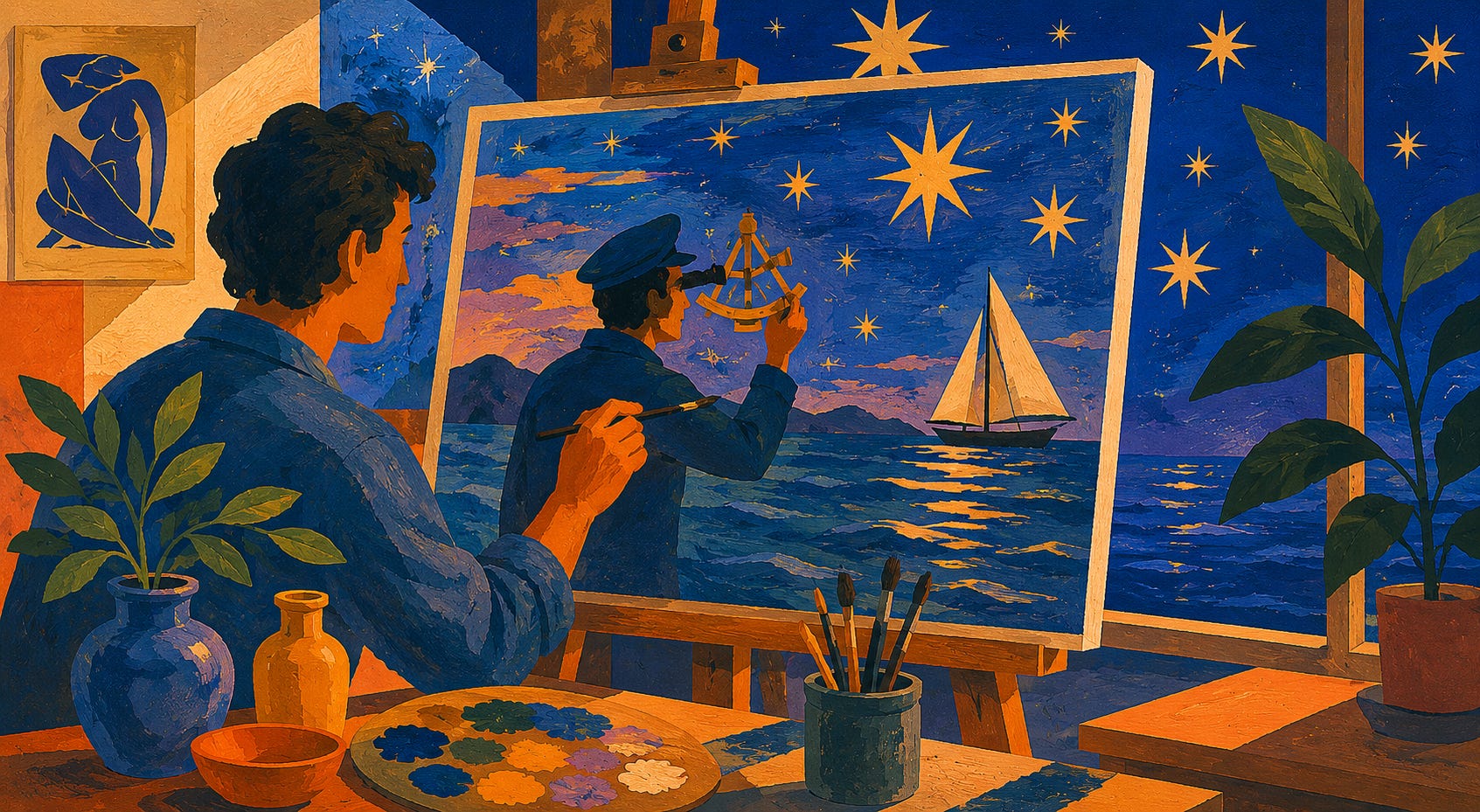
In brief
When an automating tool takes over the job a craft was paid for, the craft lasts only if its judgment can move somewhere the tool cannot follow.
There are two directions. Painting, once the camera took likeness, climbed into interpretation, the higher ground of deciding which appearance is worth keeping. Celestial navigation, once GPS took the position fix, sank to lower ground, the fallback you can still trust when the signal is jammed or spoofed.
Ground existing is not the same as anyone standing on it. None of the survival is automatic; it waits on someone doing the work of the move.
Timing sets the price. Retention, moving the judgment early while the old tool still works, is cheap and nearly impossible to defend in a budget meeting. Reinstatement, rebuilding after the loss is on the front page, is slow, costly, and never as deep as what was let go.
The verdict of 1839, painting is dead, is being read out again now over many crafts at once. Care is the early choice to move a craft’s judgment to safer ground before the loss forces it.
When the daguerreotype was unveiled in Paris in 1839, the verdict on portrait painting arrived quickly, and it was not unreasonable. A portrait painter sold likeness. Likeness was the product, the thing a client paid for. And here was a machine that produced likeness in minutes, at a fidelity no hand could equal, at a fraction of the cost, available to anyone able to sit still in front of it. The painter who made a living from faces was now competing with physics, and physics does not tire, does not flatter, and does not raise its rates.
The painter Paul Delaroche is supposed to have declared, on seeing the new images, that from that day painting was dead. The line is almost certainly apocryphal. It survived for a century anyway, because it named something a great many people felt at once: a craft had met its replacement, and the replacement was better at the exact thing the craft was paid for.
The verdict was wrong. Portrait painting did not die in 1839, or in the decade after, or in the century after that. The same verdict is being delivered again now, against a long list of crafts at once, by serious people reasoning soundly from real evidence. Why was it wrong the first time?
The camera took a job, not a craft. For most of its history, portraiture had carried a documentary burden. Before photography, if you wanted to know what your grandfather had looked like, or your sovereign, or yourself at thirty, a painter was the only instrument available. Part of what the portrait painter was being paid for was accuracy: a reliable record of a particular face. The painter was, among other things, a verification device. The camera did that job better, and within a generation the documentary burden simply lifted.
Relieved of the burden, painting moved. Released from the obligation to be accurate, painters became free to be something else: to paint the way light behaved rather than the way a face was shaped, to paint perception itself, the impression rather than the object, and then, a few decades on, to leave resemblance behind altogether. Impressionism, and everything that followed from it, was an expansion into ground the camera could not reach. A historian of art would rightly complicate that sentence: photography was one pressure on nineteenth-century painting among several, not a lone cause. But the direction holds. The painter’s judgment moved to higher ground, away from the record of appearances and toward interpretation, because a machine that can reproduce an appearance still cannot decide which appearance is worth holding. The care in the work moved with the judgment, upward, out of the machine’s reach.
Nobody organized this. There was no committee, no syllabus, no institution that convened to move the painter’s judgment somewhere safer. Painters drifted, individually and across decades, toward the work the camera had left them. What each of them did was deliberate, in the sense that a person chose it, and unplanned, in the sense that no one was steering. It happened in good time, while the old craft was still alive enough to feed and house the people making the move.
Now leave the studio, because one example is not a law. A single craft surviving a single tool could be luck, or charm, or the particular forgivingness of the art market. To find out whether there is a principle here, you need a second craft, and it helps if the second craft is as unlike the first as possible.
Consider celestial navigation.
A painter makes an object and offers an interpretation. A navigator, working with a sextant and a chronometer and a set of tables, produces a single number, or rather a pair of them: a latitude and a longitude, the answer to one question. Where am I. There is no room in that answer for interpretation, no style, nothing personal; the navigator is not expressing anything, only locating a ship on the surface of the earth, and the ship’s company would very much prefer the location to be correct.
And yet celestial navigation was a craft in the fullest sense, demanding years to learn and a lifetime to keep sharp. It rested on instruments that are among the highest achievements of mechanical art. The marine chronometer in particular: John Harrison spent decades of the eighteenth century building a clock that could keep accurate time at sea, through temperature swings and the constant motion of a ship, because an error of a few seconds meant an error of miles. His H4, finished in 1761, is one of the objects you point to when you want to show what human craft is capable of. For two hundred years after it, finding your position at sea meant a sextant, a chronometer, the tables, the arithmetic, and a person who had been taught to bring them together under a clouded sky.
Then GPS arrived, and did to the navigator exactly what the daguerreotype had done to the painter. It took the job, producing the position faster, more accurately, and with no skill required at all. But the navigator had nowhere upward to go. Painting could climb from likeness into interpretation; there is no interpretation of where am I. The position fix was the whole of the craft, and the position fix was exactly what the satellite delivered. A craft with nowhere to move simply ends, and celestial navigation did. The United States Navy stopped training its officers in it in 2006; the academies let it lapse. For roughly two decades, celestial navigation looked like the thing photography had only threatened to make of painting: a craft simply switched off.
Before celestial navigation could come back, something had to go wrong with GPS. The signal feels like bedrock, a fixed feature of the modern world. It behaves more like a radio broadcast: a set of faint transmissions from satellites twenty thousand kilometers away, and a faint signal is easy to drown out and easy to imitate. Drowning it out is called jamming. Imitating it, feeding a receiver a confident and false position, is called spoofing. Both had been understood in theory for as long as GPS existed; what changed, recently, is that they stopped being theoretical.
Over the past few years, this kind of interference has moved from the margin of aviation to its center. The International Air Transport Association now calls its frequency crisis-level, with reported incidents in 2025 running close to triple their level two years earlier. The Federal Aviation Administration recorded spoofing reports more than doubling in the first half of 2025 alone, and noted that the problem no longer stays inside conflict zones: it now reaches aircraft hundreds of miles from any war.
The consequences are not abstract. An Azerbaijan Airlines flight went down in December 2024 after encountering electronic interference and losing reliable navigation near Grozny, killing dozens of those aboard. The following August, an aircraft carrying the president of the European Commission lost its GPS signal on approach to an airport in Bulgaria, and the crew landed on paper charts. By January 2026, thirteen European nations bordering the Baltic and the North Sea had issued a joint warning about the same disruption spreading across their shipping lanes.
The tool that had retired celestial navigation could now be switched off, or quietly corrupted, by a hostile party at a time of its choosing. What the modern ship and the modern aircraft had been standing on turned out to be a surface, not bedrock, and there were people working to crack it.
And so celestial navigation came back. It came back in three places at once, none of them taking its cue from the others.
The United States Navy, having retired the skill, began teaching it again, and said plainly that this was not nostalgia. Officers needed to find their ship without satellites, because satellites could be taken away from them. A sextant has a quality no modern system can match: it receives nothing, transmits nothing, and depends on nothing but the navigator, the instrument, and the sky. It cannot be jammed, because there is no signal to jam, and it cannot be spoofed, because there is no channel to feed a lie into. The Coast Guard kept the skill alive aboard its training ship, where cadets still take sextant sights under sail.
In civil aviation it was not one institution but a whole industry that went back to rebuild a competence it had let weaken. Airlines and regulators began retraining pilots to notice when the navigation picture had gone wrong, and to fall back, deliberately, on older methods: inertial systems that track position with no outside signal, ground-based radio aids, the plain discipline of checking one source against another. The FAA wrote, and then revised, a guide to help crews do exactly that. The crew that landed the Commission president’s aircraft on paper charts was not improvising but executing a fallback someone had decided, in advance, to keep ready.
The quietest comeback had no institution behind it at all. Among ocean sailors, celestial navigation has become something people learn on purpose, for its own sake, with no regulator requiring it of them. It belongs now to the same cultural current that brought back the vinyl record and sustains the mechanical watch: a deliberate attachment to a way of working that the efficient option had made optional. People want to own a sextant, and, more than that, to know how to use one.
In every one of these, the craft’s judgment had moved, exactly as the painter’s once did, and it had not moved in the same direction. The painter’s judgment moved upward, into interpretation. The navigator’s moved downward, underneath the tool, into the role of the thing you stand on when the tool fails. Celestial navigation survived by becoming the floor: the position you can always recover, the answer that cannot be taken from you, the thing still true when everything with a power supply has been switched off.
Put the two crafts side by side. The same rule governs both of them. When an automating tool arrives and takes over the function a craft was paid for, the craft survives only when its judgment can be moved somewhere the tool does not reach. Painting found that ground above the tool, in interpretation, in the decision about which appearance is worth holding, a decision a machine that copies appearances can never make. Navigation found it beneath the tool, in resilience, in being the source that holds when the convenient source is attacked. Above or beneath, the principle holds: the tool is never the whole story. What decides the outcome is whether the craft has higher or lower ground to move to, and whether anyone does the work of moving it there.
Painting’s move happened in good time. It happened gradually, across decades, while the old craft of likeness was still alive enough to support the painters drifting toward the new work. There was no gap. No generation of painters found itself with the documentary job gone and nothing yet built to replace it. Painters were moving into the new work before the old work was fully gone, and that overlap was the safety margin.
Navigation’s move did not happen that way. The skill was allowed to lapse first. The Navy stopped teaching it, the academies dropped it, and for two decades the craft thinned toward a handful of enthusiasts, because the tool was working and the craft looked like cost without benefit. The move had to happen afterward, in a hurry, under pressure, after a passenger aircraft had already come down. The competence was rebuilt, which is the good news. But it was rebuilt at the worst possible time, at the highest possible price, in answer to a danger already loose in the world.
Painting and navigation are the two ways a craft’s judgment ever reaches safer ground, and the two do not cost the same. Painting shows the cheap one. Call it retention: you keep the judgment alive and moving while the convenient tool still works perfectly, while there is no visible reason to bother, while the effort looks indistinguishable from waste. It is cheap, and nearly impossible to defend in any meeting where someone is holding a budget, because its whole value is insurance against a loss that has not happened yet and may be years away.
Navigation shows the expensive one. Call it reinstatement: you let the craft lapse, then rebuild it after the tool has failed and the loss is on the front page. It is slow and costly, always done in an atmosphere of alarm, and the version you manage to rebuild is never quite as deep as the one you let go.
Care here is not affection for old instruments, or a taste for doing things the hard way; it is the early decision, the choice to move a craft’s judgment while moving it is still cheap, before there is proof the move is needed. The discipline is making that choice. Everything after it is recovery.
The verdict from 1839 is being delivered again now, against more crafts at once than at any time I can readily think of.
A tool has arrived that generates. It writes, it drafts, it designs, it produces analysis and images and code, quickly and cheaply and at a level of fluency that is genuinely new. And around it, the same serious people are doing the same sound reasoning. They look at a craft, identify the function it is paid for, observe that the machine now performs that function faster and cheaper, and conclude that the craft is finished.
The daguerreotype says they are probably wrong. The question is not whether the machine can do the job. The machine can do the job; that much is settled, and arguing about it is mostly a way of avoiding the harder questions. What was this craft actually for, underneath the function the tool has taken? And where can its judgment stand: is there higher ground, the equivalent of interpretation, work the machine cannot reach because it calls for deciding what is worth doing rather than doing it? Or lower ground, the equivalent of celestial navigation, the role of the thing that holds when the fluent, convenient tool produces something confident and wrong?
For most crafts I can think of, both kinds of ground exist. I want to be careful with that claim, because I cannot prove it, and there may well be crafts whose whole purpose a machine can occupy with nothing left above it or beneath it. But most crafts have more ground than their practitioners fear. What is never guaranteed is the move. Ground existing is not the same as anyone standing on it.
What happens next is up to us. Obsolescence is not a verdict handed down by a tool; it is what happens to a craft when nobody does the work of moving its judgment in time. The tool does not abolish the craft, it makes it optional. What happens after that depends on whether the people who hold the craft treat optional as a synonym for finished, or as the description of a choice that has just become theirs to make.
The painter kept working at the easel after the easel stopped being the only way to record a face. The navigator still takes a sight with a sextant after the sextant stopped being necessary to find the ship. Both are doing, on purpose, the thing the machine made optional, and that is not nostalgia but the discipline of care, practiced early, while it is still cheap. It was always available. It still is.